
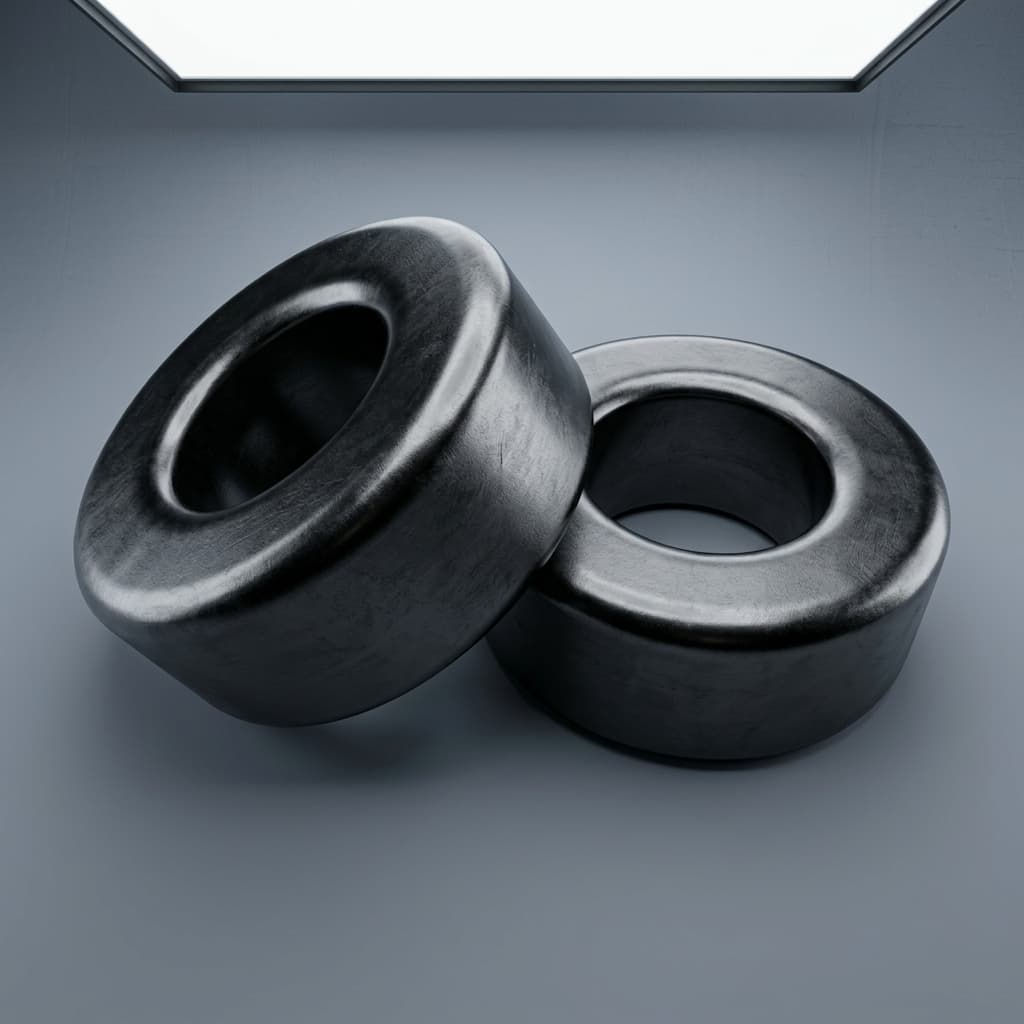
Laminated SmCo Magnets: Eliminating Eddy Current Losses in High-Speed Motors
An engineering deep-dive into how laminated Samarium Cobalt magnets break the thermal limits of high-RPM motors (Formula E, UAVs, Turbomachinery) by suppressing eddy currents.
When motor speeds exceed 50,000 RPM (e.g., in Formula E traction motors, turbo-compressors, or UAV propulsion), the biggest enemy isn't mechanical stress—it's Eddy Current Loss.
Because Samarium Cobalt (SmCo) and Neodymium (NdFeB) are metallic, they conduct electricity. As the motor spins at extreme frequencies, the changing magnetic fields induce intense electrical currents inside the solid magnet block itself. This creates massive internal heating, pushing the magnet toward its demagnetization knee point and destroying motor efficiency.
The ultimate solution for high-speed rotors is Laminated SmCo Magnets. By slicing the magnet into thin layers and bonding them with high-temperature dielectric insulating glue, we sever the conductive pathways and suppress eddy currents entirely.
The ROI of Lamination
Instead of writing complex Maxwell equations, try our interactive calculator below. Adjust your motor RPM and see how reducing the lamination thickness slashes internal heat generation compared to a standard 5mm solid magnet.
Note: The actual temperature drop depends heavily on the rotor cooling jacket and stator slot harmonics, but the internal heat generation reduction is nearly exponential as thickness decreases.
Engineering the Perfect Lamination
Laminating SmCo is significantly more difficult than laminating NdFeB because SmCo is extremely brittle. It cannot be easily sliced into 0.5mm wafers without high scrap rates.
Here is what you must specify to ensure a reliable laminated SmCo rotor:
1. The Insulation Layer (Dielectric Glue)
Standard epoxies burn off at 150°C. If the glue fails, the laminations short-circuit, and eddy currents return instantly. You must specify aerospace-grade insulating adhesives (e.g., Polyimide or specialized silicon-based epoxies) capable of surviving 250°C continuous operation. The glue line thickness is typically controlled between 10μm and 20μm to maintain a high magnetic fill factor.
2. Machining Tolerances and Assembly
Laminating the magnet after it has been fully ground to shape is impossible. The manufacturing sequence must be:
- Sinter block.
- Slice into thin wafers.
- Apply dielectric coating to each wafer.
- Stack and cure under pressure.
- Machine the final block/arc shape from the bonded stack.
This means the dielectric glue must also withstand the sheer forces of final CNC grinding.
3. SmCo5 vs Sm2Co17 in Laminated Stacks
While Sm2Co17 offers higher Remanence (Br) and is the default for high-performance motors, it is much more brittle than SmCo5. When specifying laminations below 0.3mm for ultra-high speeds (>100,000 RPM), the machining yield for Sm2Co17 drops. In some extreme micro-turbines, switching to SmCo5 allows for thinner, intact laminations, and the resulting reduction in eddy currents actually yields a higher net system efficiency despite the lower baseline Br.
Field Evidence Snapshot
- Application: 120,000 RPM Electric Turbo-Compressor
- Failure Mode Observed: Rotor temperatures exceeded 280°C with solid Sm2Co17 magnets, causing partial irreversible demagnetization and 8% efficiency loss.
- Corrective Action: Upgraded to 0.5mm Laminated Sm2Co17 with 250°C rated polyimide binder.
- Result: Rotor temperature stabilized at 190°C. Motor efficiency increased by 6.5%, and demagnetization risk was entirely eliminated.
Related Internal Guides
- SmCo5 vs Sm2Co17: How to Choose
- SmCo Machining and Tolerance Risk Control
- SmCo RFQ Checklist for OEM Buyers
External Standards and References
- IEEE Magnetics Society - Eddy Current Loss Research
- MMPA Standard Specifications for Permanent Magnet Materials
Next Steps for Motor Designers
Do not finalize your rotor slot design without evaluating the fill-factor tradeoff of laminated magnets. The thinner the lamination, the less magnetic material you have, but the cooler the motor runs. Finding the optimal intersection requires precise thermal-magnetic modeling.
Bring your target RPM, harmonic frequencies, and cooling capacity to the engineers at SmCo Supply. We provide fully bonded, pre-ground laminated SmCo arc segments ready for sleeve integration.
Author

Application Engineering Specialist & Founder at SmCoSupply. Expert in high-temperature samarium cobalt magnet applications and OEM production scaling.
- Reviewed against real RFQ and sample handoff workflows.
- Updated when buyer-side acceptance criteria materially change.
- Intended for engineering and procurement decision support.
Categories
More Posts
SmCo Magnet Cost Drivers: Tolerance, Grade, and Machining Yield Breakdown
SmCo magnet cost drivers explained for buyers: compare tolerance, grade, and machining yield risks, then request a drawing review before RFQ.

SmCo Magnet Air Freight Compliance and Shielding Packaging Guide (IATA 953)
Use this SmCo magnet air freight guide to plan IATA PI 953 testing, shielding packaging, documentation, and chargeable-weight estimates before RFQ release.
High-Temperature SmCo Validation Plan: From Sample to Release
A validation planning framework for SmCo applications that operate under sustained heat, thermal cycling, and long service-life requirements.